
The guest editor, Dr. Fred Dejonckheere, is a physician and healthcare strategy and leadership professional with expertise in pipeline development and market access, based in Basel, Switzerland, and works in the pharmaceutical industry. This overview article on trials developing treatments for post-acute infection syndromes (PAIS) was created in his role as a doctor and carer. The views expressed in this guest article represent solely the personal opinions of the author.
Note by the ME/CFS Research Foundation on the guest article
Dr. Fred Dejonckheere is a physician and healthcare strategy and leadership professional with expertise in pipeline development and market access, based in Basel, Switzerland, and works in the pharmaceutical industry. This overview article on trials developing treatments for post-acute infection syndromes (PAIS) was created in his role as a doctor and carer. Note by the ME/CFS Research Foundation on the guest article Post-acute infection syndromes (PAIS) – including Long COVID, ME/CFS (Myalgic Encephalomyelitis / Chronic Fatigue Syndrome) and related post-infectious diseases – are receiving growing attention from the international research community. With this guest article, we aim to provide an overview of the current state of clinical research on treatments and diagnostics in this field. The article is primarily intended for readers with a scientific or clinical interest. It references numerous drugs, drug candidates, and other interventions, currently being investigated in clinical trials. In this context, the ME/CFS Research Foundations wants to points out the following:
- The mention of these interventions does not constitute a treatment recommendation.
- Many of the referenced interventions are not approved for Long COVID, ME/CFS or other PAIS and are being investigated exclusively within clinical trials, i.e. in selected patients in a strictly-controlled and clinically-monitored setting.
- Decisions regarding the diagnosis and treatment of ME/CFS and Long COVID should always be made in consultation with qualified healthcare professionals.
The analyses, assessments and forecasts set out in this guest article represent the author’s views and do not necessarily reflect the views of the ME/CFS Research Foundation. The Foundation does not provide any guarantees for the accuracy or completeness of the information provided in the article. However, as a Foundation, we consider this article a valuable contribution to the discussion surrounding progress in ME/CFS treatment research, as well as the potentially growing interest from the pharmaceutical industry, and are therefore making it available to our readers.
The original article was posted by Dr. Dejonckheere on 9 January 2026 on LinkedIn (external link). This article contains an updated version of the Top 100 list compared with the original, along with adjustments to the text and a German translation.
Guest article by Dr. Fred Dejonckheere
Preliminary remark
This clinical audit and the market visions expressed herein are entirely my own and were developed independently of my professional activities. This material does not represent the stance of my employer or its partners. Furthermore, identifying clinical assets or market opportunities does not constitute an endorsement or investment advice; readers should perform their own due diligence. I have not received any financial compensation from any third party requesting to publish or distribute this text.
Introduction
Blockbuster drugs are the essential financial engines of large pharmaceutical companies, typically generating over 80% of gross revenue. These franchises are built not merely on patient volume, but on achieving a durable, dominant position by exploiting new, actionable biological mechanisms, ideally first and best in class.
The source of such commercially successful innovation is two-fold: internal research engines and external assets sourced via licensing, partnerships, and mergers and acquisitions. Interestingly, about 45–50% of big pharma pipeline assets come from external innovation, but these externally sourced assets tend to represent a disproportionate share (about 65%) of revenue value, meaning the next commercial giant is likely incubating in the external innovation landscape, awaiting the right strategic partnership (McKinsey, 2022 – external link). Such ventures, if successful, are often transformative. This business model has generated a wealth of innovation across both major and niche therapeutic areas over decades.
The key to anticipating that next big market on the horizon is tracking the most reliable leading indicator: the density and diversity of small biotech companies and academic programmes entering a given disease area. This 'clustering' not only signals a large societal and growing scientific interest, but also that a solution is realistic and is being de-risked, and a blockbuster market is poised to emerge. Industry analysts, such as McKinsey, refer to this phenomenon as 'Herding'—a critical metric indicating that collective research and development (R&D) intelligence has converged on a viable mechanism, validating the biology enough to unlock significant capital.
Such a clustering pattern was clear in rheumatology (preceding the success of anti-TNFs like Humira), immuno-oncology (leading to checkpoint inhibitors like Keytruda), multiple sclerosis (leading to B-cell depleting therapies like Ocrevus), and most recently, in obesity and metabolic disease (GLP-1–based drugs like Ozempic). History confirms the predictive power of this signal: in every instance, these clusters matured into massive, multi-billion-dollar blockbuster franchises.
The current blockbuster market: commoditisation on the horizon
While the current blockbuster market is generating vast revenue, it is also becoming saturated. Multiple products with very comparable mechanisms of action and efficacy are entering, pricing pressures are already emerging, and future competition from biosimilars and payor-driven cost constraints threatens to erode long-term margins. The market might indeed be enormous, but the number of new winners able to carve out durable, dominant positions may be smaller than anticipated, and individual company returns could fall short of sometimes hype-driven expectations.
Meanwhile, in its shadow, an underappreciated blockbuster market may be taking shape in Long COVID and related conditions like ME/CFS, postural tachycardia syndrome (POTS), Fibromyalgia and Lyme that share a lot of their symptoms and biologic mechanisms and are increasingly being grouped under the umbrella term post-acute infection syndromes (PAIS).
Despite substantial evidence pointing to aberrant immunological processes as a shared underlying driver (also explaining why mainly women are affected by these conditions), big pharma’s involvement in this area has been surprisingly cautious so far. Part of this reluctance may stem from historic misconceptions: that these conditions would be vaguely defined, too complex, or even psychosomatic. This view persists despite a rapidly increasing number of peer-reviewed studies validating distinct biological triggers and mechanisms and actionable biomarkers, both for diagnosis, stratification and treatment evaluation.
The seismic shift: from acute crisis to a unified frontier
- The COVID-19 pandemic triggered an undeniable surge in patients presenting with symptoms strikingly similar to ME/CFS—an underrecognized condition studied for decades by a handful of pioneering research centers (like the Charité — Universitätsmedizin Berlin, with Prof. Dr. Scheibenbogen, and Stanford University with Prof. Dr. Ron Davis).
- Parallel to this, the pandemic unleashed a massive wave of patients presenting with the objectively measurable hemodynamic dysfunction of POTS, with recent data confirming that nearly one-third of severe Long COVID patients meet the objective diagnostic criteria for this condition (Björnson et al., Circ Arrhythm Electrophysiol, 2025 – external link).
- The staggering volume of new patients and the consistency of prevalence rates and symptom patterns across countries refute a psychosomatic hypothesis. This was definitively validated by the 2025 OECD PaRIS survey, which aggregated data from over 100,000 patients across 19 countries to confirm that approximately 7% of the primary care population suffers from Long COVID, reporting severe deficits in physical function and quality of life with significant proportions of individuals unable to return to work, that are consistent across borders (OECD, 2025 – external link).
- The direct link between acute viral infection and the complex chronic pathology observed in Long COVID, and the obvious overlap with related conditions like ME/CFS and POTS are scientifically sound (Davis et al., Nat Rev Microbiol, 2023 – external link), as recently also formalised by Prof. Iwasaki’s team (Miller et al., Trends Immunol, 2025 – external link).
Driven by these insights and the relentless advocacy of very vocal patient organisations (reminiscent of the HIV/AIDS activism of the 1980s), attention is now pivoting from containing the acute COVID-19 crisis through vaccines, antivirals, and monoclonal antibodies to the long-term sequelae (Long COVID) and the overlap with related (pre-pandemic) conditions like ME/CFS and POTS. The shift is profound:
- Scientific mobilisation: a 2025 bibliometric analysis confirmed that publications on Long COVID alone grew at an annual rate of 20%, demonstrating the accelerated mobilisation of global scientific attention after the acute crisis subsided (Daodu et al., medRxiv, 2025 – external link).
- Mechanistic validation: intense research efforts confirm the large overlap of many of the symptoms and biologic mechanisms with related illnesses like ME/CFS, POTS, Fibromyalgia and Lyme—in particular pathogen persistence or reactivation, neuroinflammation, autonomic dysfunction, impaired microcirculation, microbiome dysbiosis, metabolic dysfunction and autoimmunity (Al-Aly et al., Nat Med, 2024 – external link).
Together, these conditions today represent the next high-burden, underserved therapeutic frontier: Post-acute infection syndromes (PAIS), a high-value, unavoidable market, estimated to affect over 400 million people (predominately women) globally (Al-Aly et al., Nat Med, 2024 & Komaroff, PNAS, 2025 – external links) and commanding multi-billion dollar government initiatives like the NIH’s RECOVER.
In Europe, health authorities are also beginning to mobilize significant capital. Germany, Europe’s largest pharma market, recently announced a landmark commitment: the launch of the “National Decade against Post-infectious Diseases” (Nationale Dekade gegen Postinfektiöse Erkrankungen). This initiative pledges €50 million annually for the next ten years specifically for research into PAIS (Long COVID and ME/CFS), designed to catalyse the domestic ecosystem of academic centres and emerging biotechs (BMFTR, 2025 – external link). The economic imperative behind this investment is enormous. With the annual societal cost of Long COVID and ME/CFS estimated at €60 billion in Germany alone (ME/CFS Research Foundation, 2026), a €500 million total commitment is a good starting point.
The asymmetric opportunity in PAIS: accelerating momentum
The rapidly evolving PAIS market presents large pharmaceutical companies with a unique opportunity to secure a strategic, durable franchise rooted in cutting-edge immunology, cardiovascular research, and neuroscience, amplified by the unfolding biotech cluster effect. The most compelling proof of the market's enduring validity is the dramatic acceleration in the diversity of therapeutic modes of action (MoAs) entering clinical trials. This signifies a departure from simple drug repurposing; it represents a rapidly expanding front of innovative, mechanism-based bets. These active trials are now testing specific assets against specific biological targets, guided by a maturing suite of novel biomarkers. The graphic below illustrates the speed at which the therapeutic pipeline has grown from simple anti-virals to multiple distinct, proprietary MoA categories between 2020 and 2025. Each of these “Top 100” interventions across the below categories is linked to at least one interventional trial with a specific MoA, in one or more PAIS populations, across one or more different centres.
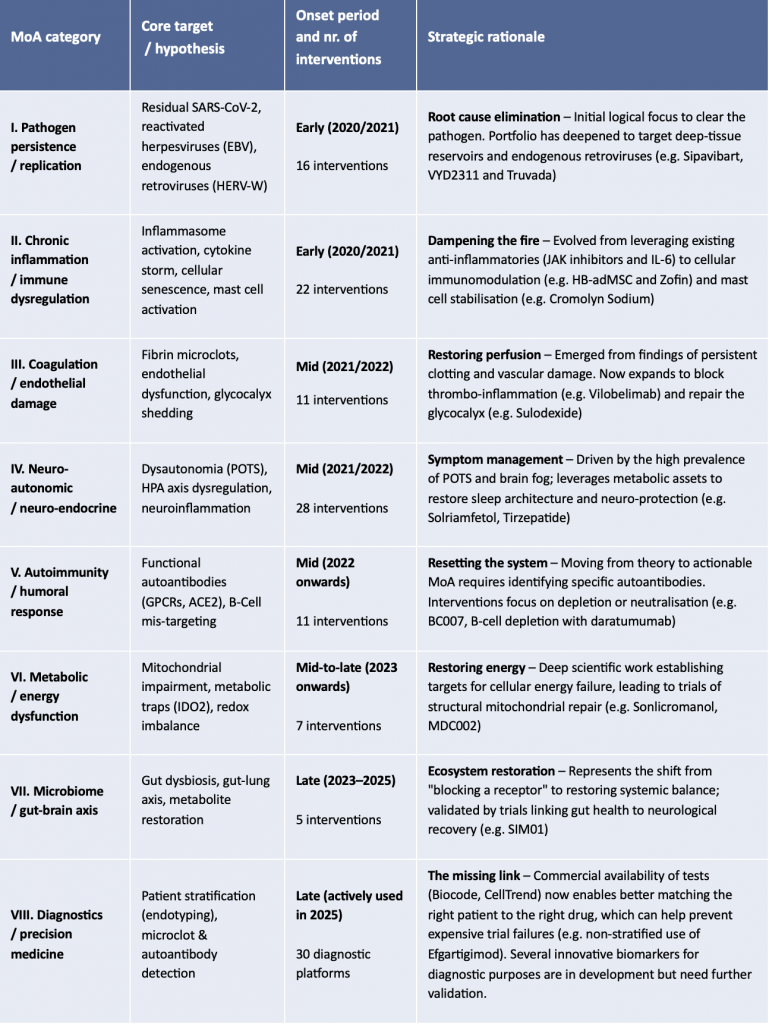
This dataset reflects a comprehensive 2025 audit of global clinical registries including ClinicalTrials.gov, the EU Clinical Trials Register (CTIS/EudraCT), and the ISRCTN. It specifically integrates the latest protocol data from major international PAIS platform trials, including the NIH RECOVER initiative (USA), STIMULATE-ICP (UK), and the multi-national RECLAIM platforms (Canada and Netherlands/EU). The selection process rigorously prioritised the top 100 therapeutic interventions with a defined biological mechanism of action targeting PAIS pathology, based on three key pillars:
- Strong biological rationale: interventions targeting specific root causes like viral persistence or neuro-inflammation.
- Active status: isolating verified, ongoing interventional trials and expert-validated protocols (including 3 failed phase 2 studies, as next steps have not yet been communicated or the intervention is on market in other indications).
- Strategic relevance: prioritising distinct, high-impact mechanisms that fill specific voids in the treatment landscape rather than supportive care.
The full list of resulting "Top 100" interventions (Categories I-VII), alongside key diagnostic platforms (Category VIII)—mapping the specific institutions, target populations and biotech companies involved—is provided at the end of this article and may serve as a competitive map for investigators and industry stakeholders to identify high-value collaborators and market opportunities in a specific segment.
A granular audit of this pipeline confirms that the PAIS market has matured past sporadic experimentation and starts to meet the formal industry definition of a de-risked opportunity. According to R&D innovation metrics (e.g. McKinsey's "Charting the path to patients" – external link), a therapeutic area signals commercial validation—or 'Herding'—when more than five distinct candidate medicines pursue the same biological target.
This requirement seems fulfilled across multiple high-value nodes. Competition is accelerating in each of the following categories: viral reservoir persistence (spanning novel proteases to monoclonal antibodies), autoimmunity (ranging from B-cell depletion to aptamer neutralisation), microcirculation (from anticoagulants to therapeutic apheresis), chronic inflammation (targeting traditional cytokine pathways), and metabolic restoration (focused on mitochondrial bioenergetics). This competition across such diverse targets is the strongest leading indicator that the scientific risk is rapidly being retired, and the race for a blockbuster market has begun.Unlike current blockbuster markets—where multiple highly effective therapies already crowd the space and pricing pressure is inevitable—Long COVID and the broader PAIS landscape represent a pristine 'Blue Ocean' opportunity characterised by:
- Critical unmet need: A global addressable population of nearly 400 million (Al-Aly et al., Nat Med, 2024 & Komaroff, PNAS, 2025 – external links) highly burdened and often work-unabled patients with no specific approved therapies—and a proven willingness to pay out-of-pocket that likely rivals or exceeds other sectors.
- High pricing power: With zero on-label disease modifying treatments available today, early entrants will define the standard of care and have significant pricing opportunity.
- No 'winner-takes-all' risk: The complex, multi-organ PAIS pathology requires diverse therapeutic strategies and likely combination therapies, preventing any single drug from monopolising the market.
A frequent objection is that the field lacks validated biomarkers to justify major investment. This view, however, is flawed. First, history proves that biomarkers are not a prerequisite for commercial success; massive blockbuster markets, particularly in the area of psychiatry and central nervous system, were built entirely on clinical diagnoses. Second, the premise itself is becoming outdated. As the detailed overview at the end of this article (Category VIII - Diagnostics & Precision Medicine) demonstrates, the development of objective biomarkers in PAIS is accelerating rapidly, moving the field from subjective diagnosis to precision medicine. Third, the toolbox for objective verification is already far more advanced than commonly assumed. While PAIS are often dismissed as 'invisible' illness, specific subtypes like POTS and Small Fiber Neuropathy (SFN) possess well-established, gold-standard diagnostic protocols that are simply underutilised due to a lack of clinical awareness. Validated objective assessments—such as the Tilt Table or NASA Lean Test for orthostatic intolerance, skin biopsies (Intra-Epidermal Nerve Fibre Density, IENFD) which definitively visualise nerve fibre density in SFN, and specialised blood panels for functional autoantibodies—are already available today to confirm diagnoses and guide therapy.
For early movers capable of validating a therapy and navigating the regulatory landscape, the potential for a category-defining, high-margin franchise is immense. The strategic prize in PAIS is not about achieving incremental efficacy over competitors (like in other blockbuster markets), but about being the first to deliver a disease modifying or solid symptomatic treatment that materially reduces both the clinical and economic burden for a vast, waiting patient population, their families, and society at large.
The "investment gap": who Is funding PAIS solutions?
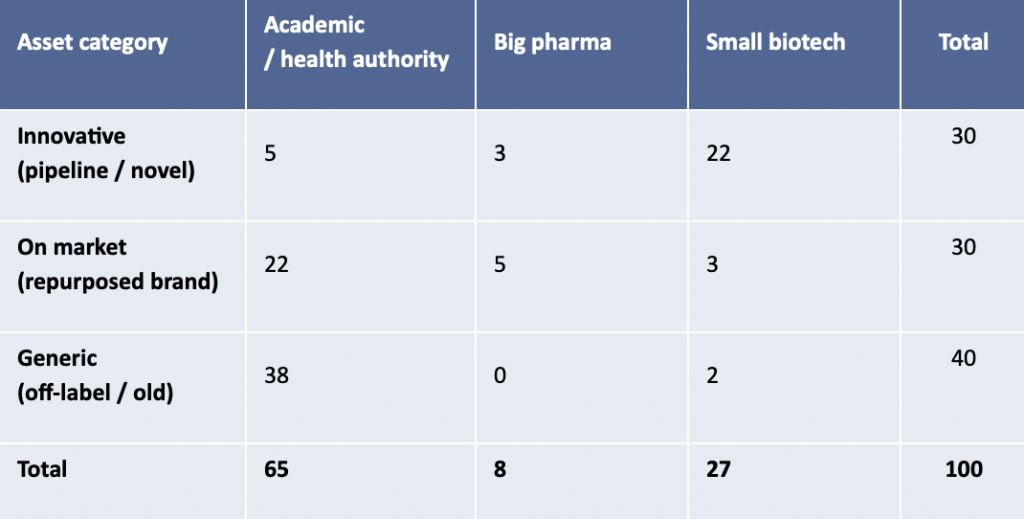
Further analysis of the “Top 100” interventions in the PAIS landscape reveals a unique "investment gap" (see table 2). The pipeline is split into three distinct segments across innovative (new assets), on market (repurposed brands), and generic (off-patent drugs). The generic category has been uniquely dominant, comprising 40% of the landscape and driven almost exclusively by academic and health authorities. This intense activity reflects the desperation of the unmet need compared to other fields: expert centres are urgently repurposing every available tool—from Metformin and Low-dose Naltrexone (LDN) to common antihistamines (like Loratadine and Famotidine) and centrally-acting neuromodulators (such as Amantadine and Ketamine)—rather than waiting for years-long and costly de novo development.
Perhaps most surprisingly, these public institutions are also leading key innovative projects, driving forward novel concepts like IDO2 inhibitors and targeted microbiome synbiotics (the LIMIT trial) that the private sector has yet to embrace. Meanwhile, big pharma’s involvement so far is largely concentrated in the on market segment, often acting merely as suppliers for government or privately-funded trials rather than primary sponsors, whereby the actual trial sponsor is a government body like NIH RECOVER.
However, the outlook is far from stagnant. Despite industry caution, small biotech companies (along with big pharma players AstraZeneca, Regeneron and Shionogi) are aggressively filling the void, driving the Innovative share of the pipeline (over 25%). These agile players are taking high-risk bets on novel mechanisms, ranging from next-generation antivirals designed to penetrate deep-tissue reservoirs and aptamers neutralising functional autoantibodies, to precision metabolic agents aimed at restoring mitochondrial ion balance and bioenergetics. This role of biotech innovation is rapidly evolving and will soon expand beyond the generic and on-market drug repurposing that has been the dominant force in this field so far.
While the investment gap highlights a reliance on repurposing, one specific repurposed asset is bridging the divide: GLP-1. The very class of drugs driving the obesity market is now validating the Long COVID market's deep biology: The Long COVID Treatment Trial (LoCITT), led by Scripps Research, has launched a landmark study investigating the GLP-1/GIP dual agonist Tirzepatide (Zepbound/Mounjaro) for Long COVID. The trial’s rationale explicitly sidesteps weight loss to focus on the drug's potent anti-inflammatory and neuroprotective properties.
While the trial is philanthropically funded by the Schmidt Initiative, Eli Lilly has formally stepped in to supply the study drug—a strategic move that signals industry willingness to support high-quality external validation without yet committing to full sponsorship.
Conclusion: the blockbuster opportunity is now
While current blockbuster markets offer volume, they face inevitable commoditisation and intense competition. In contrast, the PAIS landscape—spanning Long COVID, ME/CFS, POTS, Fibromyalgia and Lyme—offers the rare chance to build a durable, high-margin, category-defining franchise.
The emerging scientific consensus, validated by the rapid expansion of the clinical pipeline, confirms the existence of multiple novel and actionable targets. Therapeutic approaches targeting B-cells, metabolic correction, and viral persistence represent more than incremental innovation; these are high-conviction bets on a fundamental immune system reset for millions of patients.
For major pharmaceutical players with established immunology, cardio-vascular and neurology portfolios, expanding into PAIS is a seamless strategic evolution, leveraging existing expertise in inflammation, fibrosis, coagulation and immune modulation.
The first regulatory approval of a novel, mechanism-based therapy will act as a singular inflexion point, triggering a multi-billion-dollar market unlock and validating this high-unmet-need asset class. Beyond commercial validation, such a milestone will finally confront a global economic burden now exceeding 1 trillion USD annually.
With a record number of specialised biotechs fueling a rapidly maturing clinical pipeline and big pharma definitively pivoting into late-stage PAIS portfolios, we are likely standing at the threshold of a breakthrough many have underestimated.
For leaders bold enough to look beyond current blockbuster markets, and invest in validating core PAIS mechanisms, the prize is likely to be generational leadership. The goal is not just to participate, but to deliver the “Humira” (Autoimmunity), the “Keytruda” (Oncology), the “Ocrevus” (MS), or the “Ozempic” (Metabolic) of post-acute infection syndromes.
List of the top 100 interventional trials (pdf download): click here
How can you support the work of the ME/CFS Research Foundation?
While progress has been made, there is still a long way to go before diagnosis, care and treatment of ME/CFS patients will one day become an established medical and social standard. We at the ME/CFS Research Foundation are focussing on biomedical research, which we see as a key element in solving these problems (more on this in our research funding strategy and in the recent half year report, which summarises our activities). To achieve this, we rely on broad support from private donors – those affected, relatives, families, friends, associations, schools, networks, companies, initiatives, event organisers and all supporters. If you are not able to provide direct support, you can share our stories and motivate others to help. Because only together can we achieve. this goal.
We fully translate donations and other support into scientifically excellent research, networking and ultimately visible successes, i.e. improved ME/CFS diagnostics and therapies. We are happy to work together with other organisations and initiatives - please contact us!
We appreciate all kinds of support:
Please subscribe to our newsletter:
And please help us expand our reach by following us on social media:
Thank you for your support!