While public research funding for Long COVID and ME/CFS has increased noticeably since 2020, considerable gaps remain: the majority of funds are directed toward healthcare research and observational studies, whereas the investigation of disease mechanisms and the clinical testing of treatments remain severely underfunded. These are the findings of a new systematic analysis from the ME/CFS Research Foundation. In light of the "National Decade against Post-Infectious Diseases" announced a year ago, we recommend establishing clear priorities to ensure that future funding is goal-oriented and aligned with existing research needs.
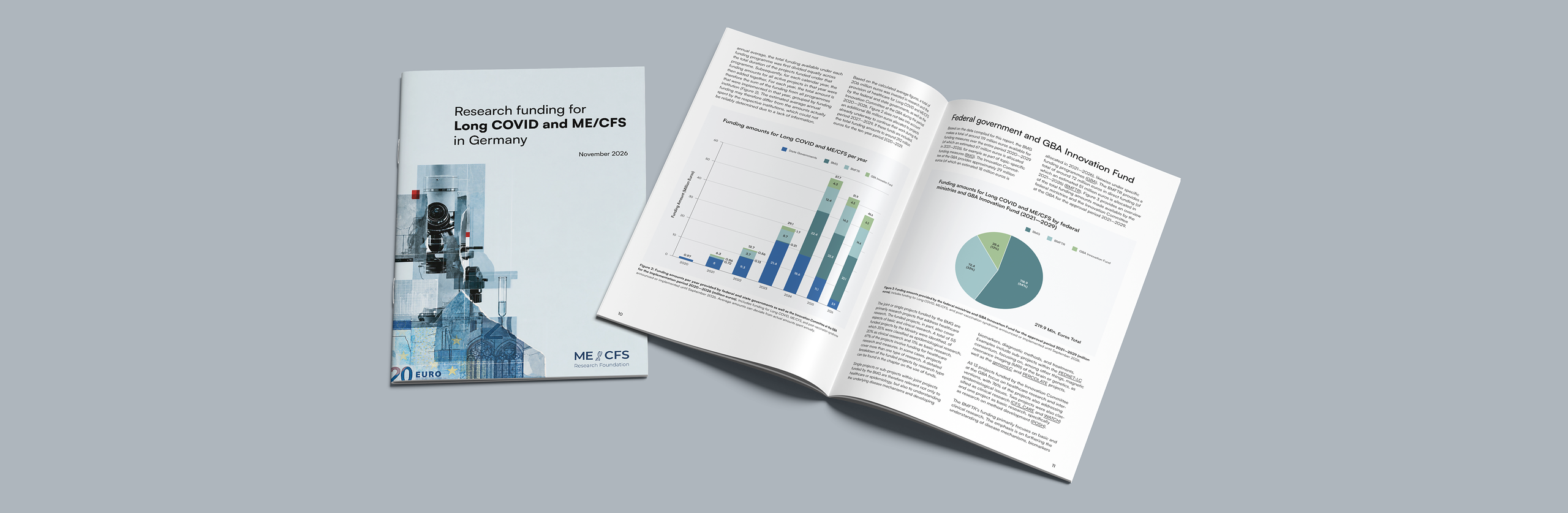
The new report provides, for the first time, an overview of publicly funded projects dedicated to research and healthcare related to Long COVID and ME/CFS in Germany. The analysis covers 259 joint or single projects, supported by a total amount of 292 million euros in funding for the period 2020–2029. Included are funding initiatives known as of September 2026.
The data show the distribution of funding amounts by source and the use of funds by disease, research type, and intervention. They allow for the classification of funding priorities set to date based on a data set that did not previously exist in this form. The aim is to create greater transparency regarding the funding landscape, sources of funding, and the use of public funds. The report is also intended to inform the process surrounding the allocation of funding around the "National Decade against Post-Infectious Diseases"and beyond and to align it with existing research needs.
Funding provided by federal government, GBA Innovation Fund and state governments
Through the funding measures implemented by the Federal Ministry of Health (BMG) and the Federal Ministry of Research, Technology and Space (BMFTR), the federal government is the largest source of funding in the field of post-infectious diseases. Between 2020 and 2026, a total of around 118 million euros in funding for Long COVID and ME/CFS research was allocated by the BMG (67 million euros) and the BMFTR (51 million euros). During the same period, the Innovation Committee at the Federal Joint Committee (GBA) spent around 18 million euros. The governments of the federal states allocated around 70 million euros between 2020 and 2026. The total funding provided by public bodies over the implementation period 2020-2026 thereby sums up to 206 million euros. Projects enabled by funding coming from the German Research Foundation (DFG) were also included, although no information was available on the exact amounts provided for this research.
If additional funding already allocated to ongoing projects and their continuation during the period 2027–2029 is included, a total of 292 million euros are being provided by public bodies over the ten year period 2020-2029. Funding by state governments makes up a third of all the funding provided by the federal government, GBA Innovation Fund and state governments.
Funding gaps in interventional and basic research
The analysis of funding provided points to a substantial funding gap for interventional studies and basic research: 7% and 20%, respectively, of the identified projects focus on these types of research, which are essential for uncovering disease mechanisms and developing biomarkers and treatments. The majority of projects fall into the categories of healthcare research and measures (42%) and observational clinical research (40%). Projects can be assigned to more than one category, so that percentages may sum to more than 100%.
Based on project numbers, as well as the funding amounts provided, the findings suggest a funding gap for basic research and interventional clinical research. Yet, these types of research are essential for the development of biomarkers and treatments, and for elucidating the underlying disease mechanisms. The aim should therefore be to fund considerably more research projects in these areas.
Treatment development and ME/CFS lack attention
Treatment research is addressed in only a small number of projects. 5% of the funded projects investigate drugs, while 4% examine device-based treatments. 68% of the projects do not investigate any interventions. The remainder are distributed across healthcare provision, exercise, behaviour, and psychotherapy. Consequently, the development of causal treatment approaches, combined with the identification and validation of suitable biomarkers and the development of diagnostic methods, must be pursued with considerably higher priority than has been the case to date.
ME/CFS, as a distinct medical condition, receives substantially less attention than Long COVID: 84% of funded projects focus on Long COVID, while 39% address ME/CFS (with some projects covering multiple conditions simultaneously). Simply giving greater consideration to ME/CFS within the context of Long COVID research (as one manifestation of Long COVID) is insufficient to overcome the long-standing research deficit related to this illness. Therefore, future funding allocation should explicitly prioritice research into ME/CFS as a distinct disease.
Research funding equals 0,1% of annual societal cost of Long COVID and ME/CFS
Even taken as a whole, the 292 million euros allocated to date across all research types over a ten-year period (2020–2029) is disproportionately low relative to the societal cost of Long COVID and ME/CFS, which amounts to around 64 billion euros annually (Daniell et al., 2026). While the societal cost amounted to around 64 billion euros in 2025, public research funding averaged only 51.9 million euros. In 2026, the average funding provided was even lower, at just 46.6 million euros. Taking into account funding already announced for 2027 and beyond, public funding would rise to a total of approximately 80 million euros per year, driven primarily by the “National Decade”. However, this will not fundamentally alter the funding to cost ratio.
Annual funding to the amount of around 80 million euros would equal only 0.1% of the annual societal cost of both diseases. Aside from the mentioned funding gaps in the area of biomarker and treatment research, there would also still be a funding gap in absolute terms, measured against the societal cost. It is all the more important to focus the still limited funding available under the “National Decade” strategically and purposefully on scientifically sound, promising approaches and on biomarker and treatment research with clinical relevance, rather than spreading support broadly without clear priorities.
Given the long-standing research deficit in the field of post-infectious diseases, most notably ME/CFS, the overarching guiding principle for the “National Decade” should be to gain as much time as possible in the development of drug treatments and their translation into standard medical care.
Recommendations for future allocation of funds
Based on the findings of the new analysis, the ME/CFS Research Foundation derives four recommendations for the future allocation of research funds:
- Close the funding gaps: Considerably increase support for basic research and interventional clinical research in order to elucidate disease mechanisms and accelerate the development of biomarkers, diagnostics, and treatments.
- Prioritise treatment development: Greater support should be provided for research into disease-modifying treatment approaches. Substances already approved for other conditions should be examined more extensively, and the development of new drugs should also be fostered. At the same time, improved symptom-oriented care remains essential.
- Strengthen research on ME/CFS: Enable research on the disease independently of its trigger. Greater focus should be placed on investigating ME/CFS as a distinct clinical entity (separate from Long COVID). Studies should employ established diagnostic criteria for ME/CFS and differentiate patient groups based on factors such as clinical characteristics and severity levels.
- Create transparency: Create a centrally coordinated, publicly accessible data repository of research funding, containing data on funding amounts, research approaches, and the activities of both ongoing and completed projects. Such an information platform can help identify research gaps and support more well-founded funding decisions.
How can you support the work of the ME/CFS Research Foundation?
While progress has been made, there is still a long way to go before diagnosis, care and treatment of ME/CFS patients will one day become an established medical and social standard. We at the ME/CFS Research Foundation are focussing on biomedical research, which we see as a key element in solving these problems (more on this in our research funding strategy and in the recent half year report, which summarises our activities). To achieve this, we rely on broad support from private donors – those affected, relatives, families, friends, associations, schools, networks, companies, initiatives, event organisers and all supporters. If you are not able to provide direct support, you can share our stories and motivate others to help. Because only together can we achieve. this goal.
We fully translate donations and other support into scientifically excellent research, networking and ultimately visible successes, i.e. improved ME/CFS diagnostics and therapies. We are happy to work together with other organisations and initiatives - please contact us!
We appreciate all kinds of support:
Please subscribe to our newsletter:
Thank you for your support!