
In the first half of 2026, we were able to reach further milestones in our work to promote more biomedical ME/CFS research. Above all, steadily increasing donations and the dedication of the Foundation’s team form the basis for our ongoing success and the momentum we have generated for ME/CFS research to date.
Our mission has remained unchanged since the Foundation was established almost five years ago: to specifically support biomedical ME/CFS research in order to facilitate the development of biomarkers, diagnostics and therapies. For only targeted research will pave the way out of the medical and social crisis that ME/CFS and post-infectious conditions such as Long COVID continue to represent for patients, their families and society as a whole.
In our work, we have continually adapted our priorities and projects to the changing research landscape and the political framework. Details can be found in our previous half-yearly reports (see winter report 2025, summer report 2025 and winter report 2024). We have once again structured this Summer 2026 half-yearly report around five areas of work:
- Funding research
- Networking of researchers
- Facts and resources for education and information
- Shaping research policy constructively
- Fundraising and awareness (including use of donations)
1. Funding research
A highlight of our work in the first half of the year was the Res Research Funding Programme 2026. In February, we launched our first open call for proposals for ME/CFS research projects . The programme supports biomedical research focusing on unexplained or poorly understood disease mechanisms, biomarkers or treatment options for ME/CFS (see the defined funding criteria). Thirty-three funding applications were submitted and subsequently assessed by a panel of international experts, as well as the Foundation’s Scientific Advisory Board and our scientific team.
Seven projects were selected from all the submissions and will begin their work in a few weeks’ time. The total funding available for this programme amounts to around 2.4 million euros and, thanks to a recent increase in donations, is actually 400,000 euros higher than the originally announced funding amount (2 million euros).
Details of the selected projects and the programme can be found in the news release on the funding programme . The newly created overview of all the Foundation’s funded projects on our website demonstrates our full commitment to research funding since 2022.
Outlook: At the end of 2026, we will reassess the landscape of ME/CFS research funding in Germany and internationally, and adjust our current funding strategy for 2027 accordingly.
2. Networking of researchers
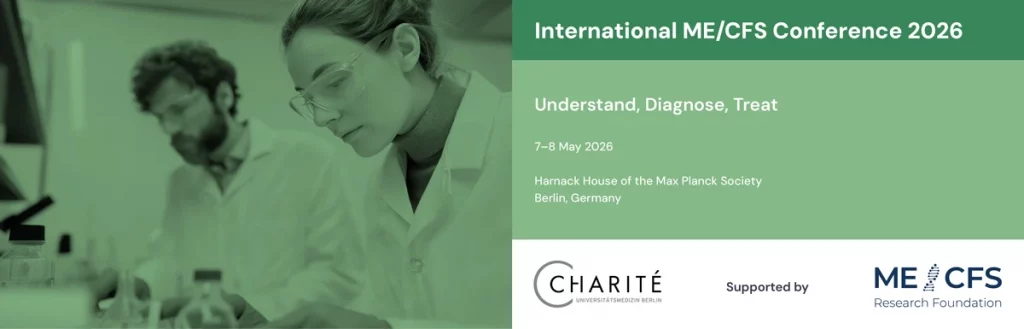
With the International ME/CFS Conference 2026 , we have once again this year organised a hybrid specialist conference in collaboration with the Charité Fatigue Centre, which took place on 7–8 May 2026 in Berlin. With a total of over 7,300 participants (280 of whom attended in person), this annual conference has now become one of the world’s largest scientific events on post-acute infection syndromes (PAIS).
The event website provides free access to the agenda, profiles of all speakers and chairs, as well as videos and summaries of the presentations . Content from previous years’ events is also still available (2025 and 2023).
In addition to events, we also use the ME/CFS Research Register, to provide information on the current state of ME/CFS research. The register offers a systematic overview of the ME/CFS research landscape, with information on research projects, working groups, publications, events and further details across six countries to date. The register will continue to be updated and gradually expanded to include new countries.
3. Facts and resources for awareness-raising and information
Following extensive use of the data from our study on the prevalence and costs of ME/CFS and Long COVID in Germany – published in May 2025 – by the press, politicians and in public debate, we published an update to the study with current data in May 2026.
The update covers data for the six-year period between 2020 and 2025 and concludes that both conditions continue to represent a significant burden on society. In 2025, over 1.4 million people in Germany were affected by ME/CFS or Long COVID.
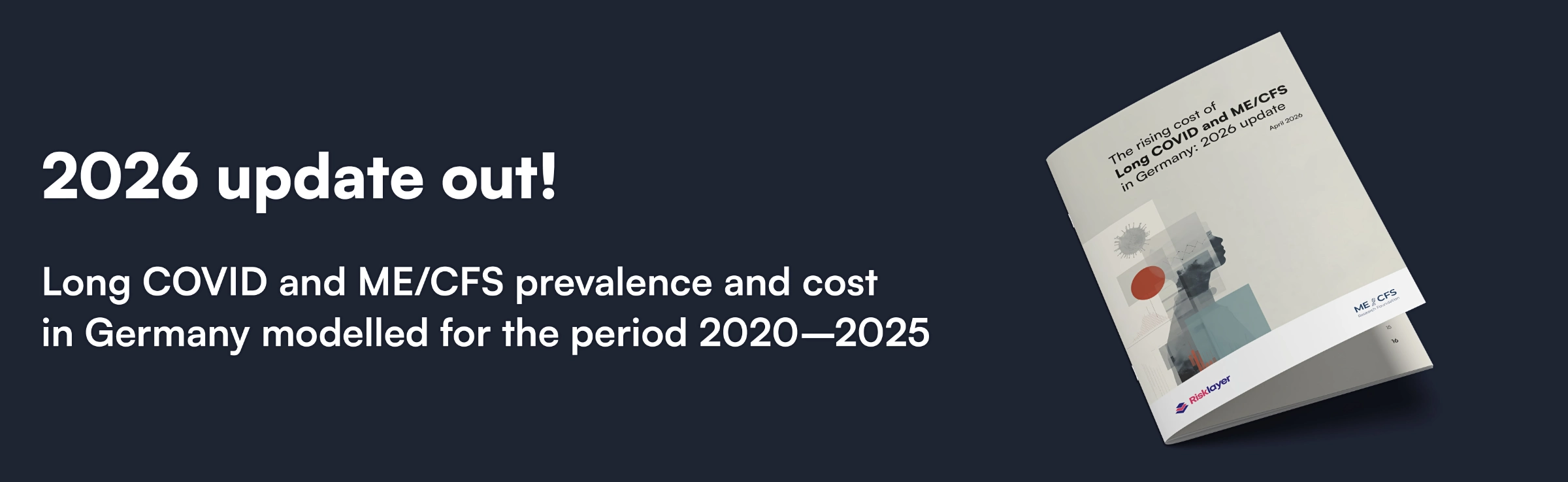
The societal costs remain high at over 64 billion euros annually. These figures underscore the enormous pressure on society to take effective action to reduce the high levels of suffering associated with these conditions amongst the population.
4. Shaping research policy constructively
With the "National Decade Against Post-infectious Diseases" (external link), the German Federal Government and the Federal Ministry for Research, Technology and Space (BMFTR) have launched one of the most ambitious research programmes to date for post-acute infectious syndromes (PAIS).
Over the ten-year period 2026–2036, 500 million euros are to be invested in research into post-infectious diseases, primarily ME/CFS and Long COVID or post-COVID syndrome. The aim is to gain a better understanding of these conditions and to be able to treat them effectively.
This public funding initiative represents a major opportunity for research into the aforementioned conditions. We are supporting the practical implementation of the “National Decade” through active and constructive contributions, for example in the form of expert opinions, active participation in the “National Decade” working groups, and within the framework of the Patient Representation Working Group (AG PatV Nationale Dekade). To date, the following activities have taken place in this context:
- Expert discussion at the Federal Government’s Research Committee: On 17 December 2025, together with other experts, we put forward key recommendations regarding the specific structure of the “National Decade”.
- Participation in working groups of the “National Decade”: In collaboration with other organisations within the AG PatV, we have been actively contributing to the work of the “National Decade” as patient representative experts since early 2026 (Data Working Group, Biobank Working Group)
- - First funding guidelines for clinical trials under the “National Decade": These were announced by Federal Minister Dorothee Bär (BMFTR) in her opening address on 8 May at the 2026 ME/CFS Symposium (the German-language section of the 2026 International ME/CFS Conference). The deadline for funding applications is 2 September 2026. Overview of the “National Decade” and the post-COVID research landscape: Prof. Dr Natascha Sommer presented an overview of activities, plans and objectives to date in her lecture at the ME/CFS Symposium 2026 on 8 May.
- Dialogue between the BMFTR and patient organisations: on 9 June 2026, the Ministry held discussions with numerous organisations working in the fields of ME/CFS, Long/Post-COVID and Post-Vac. We also took part and and have compiled the information shared by the BMFTR during the meeting for the public.
Together with the German Society for ME/CFS, the Fatigatio Federal Association and Long COVID Germany, as well as the other organisations involved in the working groups of the “National Decade” – NichtGenesen Kids and the Parents’ Initiative for Children and Young People with ME/CFS – we will continue to advocate, within the framework of the PatV working group, for a consistently patient-centred approach to the research decade and the targeted use of research funds.
5. Fundraising and awareness (and use of donations)
The financial basis of our work, particularly our own research funding, is provided by donations, which we invest entirely in our charitable work. In the first half of the year, we recorded a further increase in this income:
- A growing number of fundraising campaigns organised by patients, their families, clubs, schools, initiatives and companies on various occasions;
- Further Further awareness-raising campaigns in sport, e.g. in collaboration with the initiatives “Empty Stands” (football), “Under A Rest” and “Run for ME” (running events) and many more.
- Our ‘donation subscription’ and gift donations schemes, launched in December 2025, are enjoying growing popularity. The idea that ‘when we pool our resources, a great deal is possible’ contributes significantly to our successful fundraising.
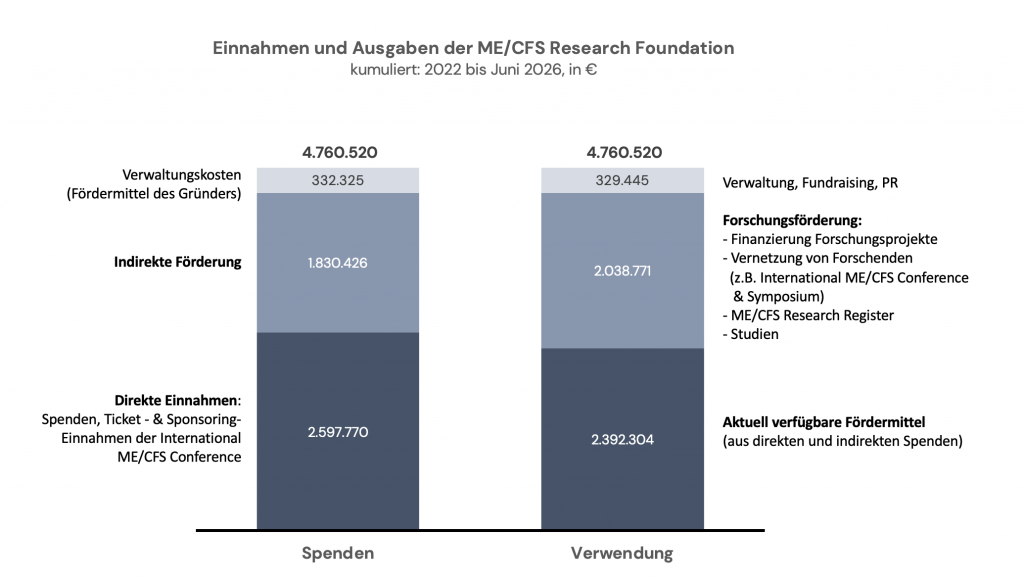
We distinguish between the Foundation’s direct income (direct donations, proceeds from ticket sales and sponsorship of the International ME/CFS Conference) indirect funding (e.g. from other foundations, which is invested in research projects in consultation with us) and administrative costs (operations and administration), the latter of which are covered by the Foundation’s founder.
Direct income for the first half of 2026, at just over 637,000 euros, is significantly higher (+97%) than the income for the same period last year. This growth is driven by a steadily increasing number of donors. Added to this are the ticket and sponsorship proceeds from the International ME/CFS Conference, which cover a large proportion of the costs of this event. Indirect grants are typically received less regularly; therefore, we only report these funds in summary form at the end of the year.
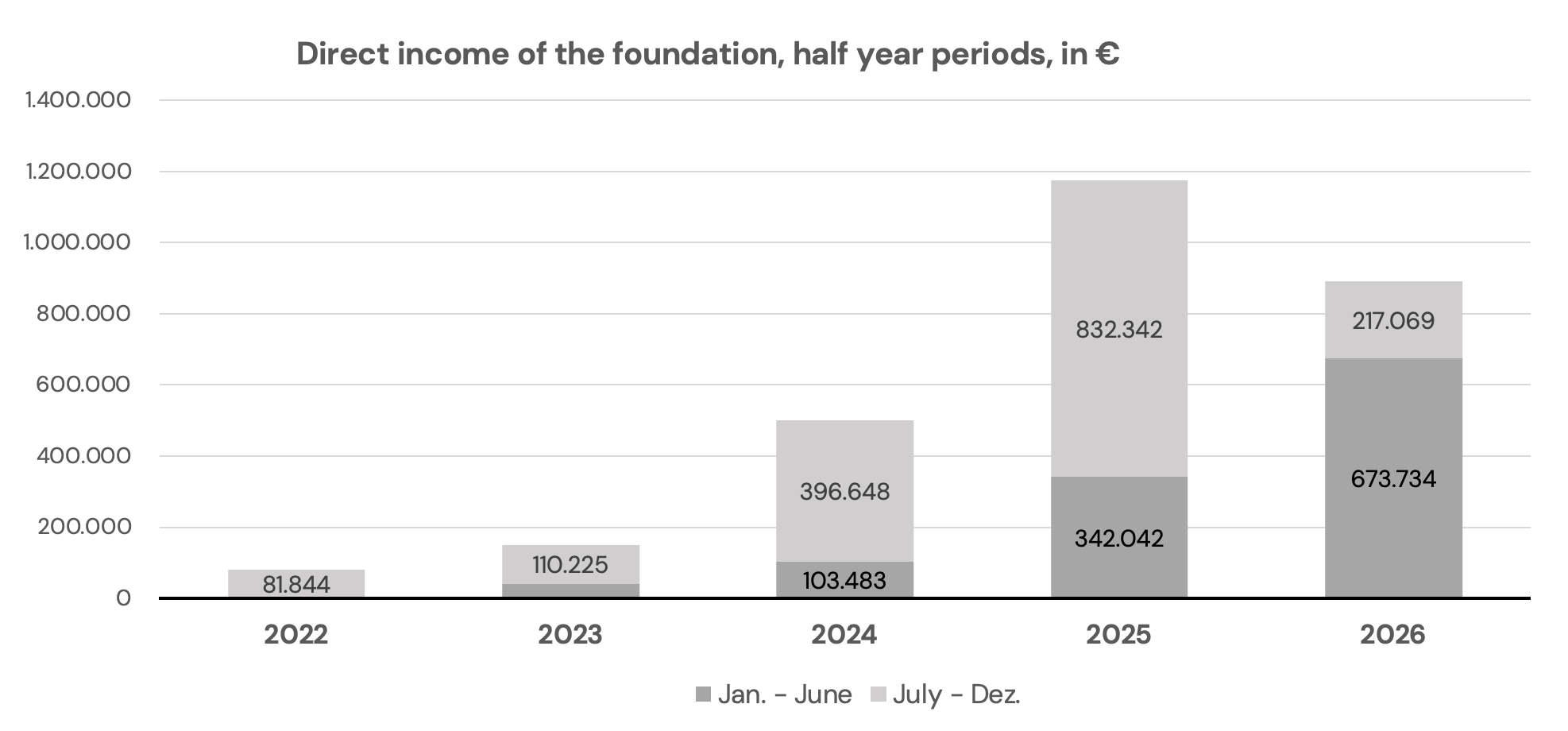
Cumulatively, over €4.76 million has been raised since the ME/CFS Research Foundation was established. Of this amount, 2.0 million euros (41.0 per cent) has been invested in research to date. A further €2.4 million is currently earmarked for new research funding, which is due to be spent this summer. The ME/CFS Research Foundation has thus invested a total of €4.4 million in ME/CFS research since 2022.Administrative costs since the foundation’s inception amount to around €0.3 million (6.6 per cent of income) and have been fully covered by the foundation’s founder. The following chart shows an overview of all the foundation’s income, expenditure and available funding to date since its inception:
Joerg Heydecke, founder of the ME/CFS Research Foundation, comments on the Foundation’s 2026 funding programme: “After almost five years of the Foundation’s work, it is clear that the basic idea works: never before in Europe has €2.4 million been invested in ME/CFS research from private sources in a single go. This demonstrates two things: on the one hand, private funding can achieve a great deal when pooled ; on the other hand, however, private funding is still not substantial enough. Only research can find sustainable ways out of this condition. Every euro invested in this cause increases the likelihood of finding solutions and shortens the path to them. All researchers confirm this to us: alongside the major public funding programmes, we still need strong private funders who can provide funding quickly and flexibly where it can be put to the best use and is most urgently needed.”
We would like to thank all our supporters!
ME/CFS research in Germany, Europe and worldwide continues to develop positively, thanks to the involvement of many researchers, patients, relatives, organisations and initiatives, as well as politicians. Our report on the prevalence and cost of Long COVID and ME/CFS shows that more research is urgently needed for the benefit of society. With the “National Decade”, Germany has the opportunity to take a leading role in biomedical research into these conditions, an opportunity that must be properly utilised both now and in the future.
We would like to express our sincere thanks to everyone who contributes to this positive development, whether through us or in other ways. And we continue to call on you to support our work for more biomedical research through donations – for better care, diagnosis and, ultimately, treatments!
How can you support the work of the ME/CFS Research Foundation?
While progress has been made, there is still a long way to go before diagnosis, care and treatment of ME/CFS patients will one day become an established medical and social standard. We at the ME/CFS Research Foundation are focussing on biomedical research, which we see as a key element in solving these problems (more on this in our research funding strategy and in the recent half year report, which summarises our activities). To achieve this, we rely on broad support from private donors – those affected, relatives, families, friends, associations, schools, networks, companies, initiatives, event organisers and all supporters. If you are not able to provide direct support, you can share our stories and motivate others to help. Because only together can we achieve. this goal.
We fully translate donations and other support into scientifically excellent research, networking and ultimately visible successes, i.e. improved ME/CFS diagnostics and therapies. We are happy to work together with other organisations and initiatives - please contact us!
We appreciate all kinds of support:
Please subscribe to our newsletter:
And please help us expand our reach by following us on social media:
Thank you for your support!