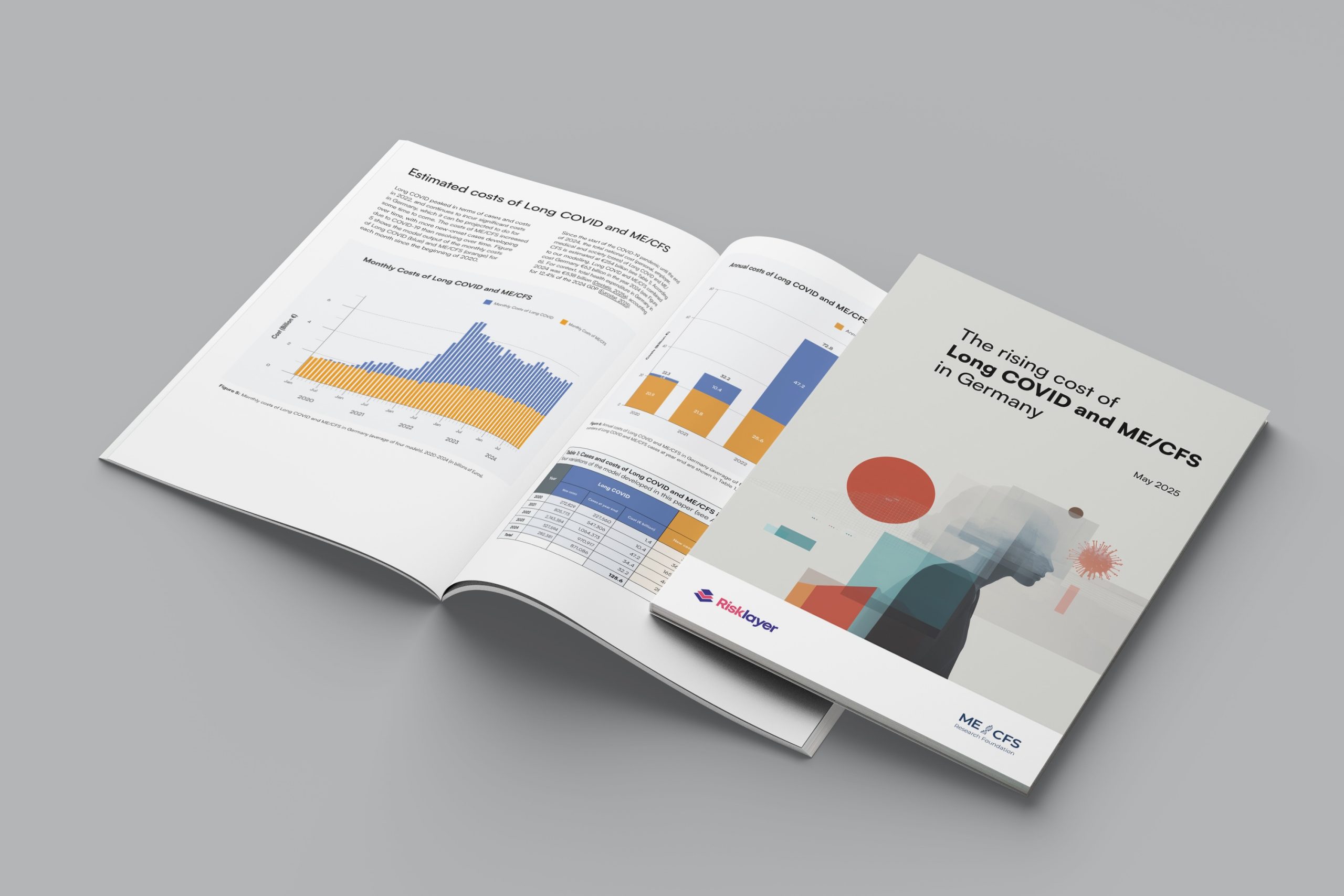
The ME/CFS Research Foundation and Risklayer, a risk modelling company, have published new data and findings on the societal costs of Long COVID and ME/CFS in Germany. The publication is an update of the study first published in May 2025. The study estimates the total annual societal costs of Long COVID and ME/CFS in Germany for the year 2025 at €64.4 billion, up from €63.1 billion in 2024. This corresponds to approximately 1.44% of gross domestic product.
According to the report, the total costs since the start of the pandemic (2020–2025) amount to over €318.8 billion. The costs were modelled using established methods for assessing the impact of disasters, which take social, medical and economic effects into account. The data model itself is available as open source for discussion.
Over 1.4 million patients – a situation that remains dire
According to the updated study, as of December 2025, more than 1.4 million people in Germany are living with these often severe and, as yet, incurable multisystemic conditions. Of these, around 757,000 people have Long COVID and a further 657,000 have ME/CFS. Whilst the number of ME/CFS cases rose slightly in 2025 compared with the previous year, the number of Long COVID cases fell slightly. Both conditions continue to lead to permanent functional limitations and incapacity to work, as they cannot be treated at the root cause due to a lack of sufficient research.
The personal hardships and economic damage remain immense
For many sufferers, Long COVID and ME/CFS result in the loss of their daily routine, their jobs and their social lives. Even young people are often unable to continue their education. Family carers take on the bulk of the caregiving, under immense strain. At a societal level, significant costs continue to arise: for medical care, nursing care, lost working hours, social security benefits and lost tax revenue. Businesses suffer productivity losses, and purchasing power is lost. The persistently high costs since 2022 demonstrate the immense societal and economic burden.
High number of unreported SARS-CoV-2 infections – resulting in new cases of Long COVID and ME/CFS
The incidence of infection remains high: in 2025, between 13 and 15 million people in Germany were infected with SARS-CoV-2. This is shown by data analyses based on viral load measurements in wastewater and reports from A&E departments and intensive care units. The actual number of SARS-CoV-2 infections is 80 to 200 times higher than the figures in the official statistics of the Robert Koch Institute (RKI) and reveals a significant number of unreported cases. The persistently high number of new infections inevitably leads to new cases of Long COVID and, with a time lag, also to new cases of ME/CFS.
Research expenditure is out of all proportion to the damage caused – there is an urgent need for biomedical research
Current analyses and a comparison with international studies show that a further rise in post-infectious diseases within the population is to be expected in the coming years. Given the lack of effective treatment options, the costs incurred are likely to remain high. The authors therefore urge targeted and effective investment in research and the development of treatments. The report recommends intensifying biomedical research through targeted investment in the development of biomarkers, diagnostics and therapies as a crucial contribution to reducing the high burden of disease. A significant reduction in costs can only be achieved by lowering prevalence, increasing recovery rates and reducing the severity of existing conditions. The report also contains further recommendations for accelerating research progress in this field.
Joerg Heydecke, Managing Director of the ME/CFS Research Foundation and co-author of the study, warns: “Our latest analyses show that, even six years after the start of the COVID-19 pandemic, Long COVID and ME/CFS continue to place a heavy burden on those affected and on society. Annual costs of €64.4 billion now stand in contrast to €500 million in government research funding announced for the next 10 years. It is crucial that these funds are allocated swiftly and effectively. The development of effective treatment options is the only way to achieve sustainable cost reductions. The success of the ‘National Decade’ will be measured by whether effective therapies become available in the coming years.”
Background: As part of the “National Decade Against Post-Infectious Diseases”, the German government plans to invest 50 million euros annually in research into post-infectious diseases between 2026 and 2036. The funding objectives formulated to date include research projects in the fields of disease mechanisms and immunology, diagnostics and biomarkers, neurology and mental health, as well as ME/CFS. Strengthening clinical trials is also a key priority.
How can you support the work of the ME/CFS Research Foundation?
While progress has been made, there is still a long way to go before diagnosis, care and treatment of ME/CFS patients will one day become an established medical and social standard. We at the ME/CFS Research Foundation are focussing on biomedical research, which we see as a key element in solving these problems (more on this in our research funding strategy and in the recent half year report, which summarises our activities). To achieve this, we rely on broad support from private donors – those affected, relatives, families, friends, associations, schools, networks, companies, initiatives, event organisers and all supporters. If you are not able to provide direct support, you can share our stories and motivate others to help. Because only together can we achieve. this goal.
We fully translate donations and other support into scientifically excellent research, networking and ultimately visible successes, i.e. improved ME/CFS diagnostics and therapies. We are happy to work together with other organisations and initiatives - please contact us!
We appreciate all kinds of support:
Please subscribe to our newsletter:
Thank you for your support!