Press release
ME/CFS – where does the research stand today?
Berlin / Hamburg, 30 April 2026
Shortly before International ME/CFS Awareness Day on 12 May 2025, leading international experts will discuss the latest research findings on ME/CFS and Long COVID.
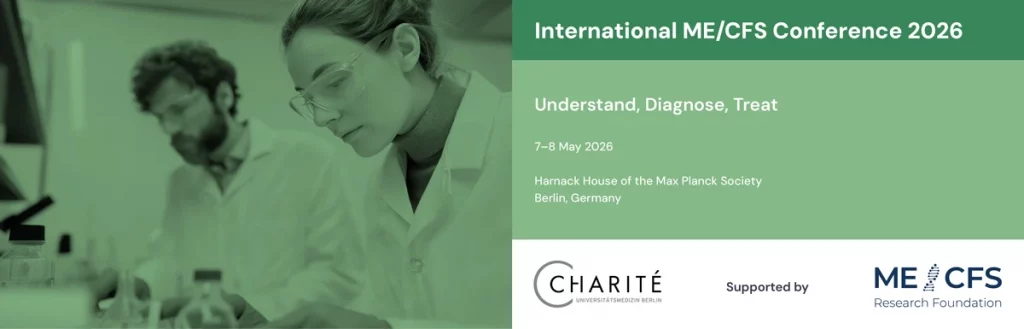
At the International ME/CFS Conference 2026, taking place on 7 and 8 May in Berlin, the latest research findings on the pathophysiology and treatment approaches for ME/CFS (myalgic encephalomyelitis/chronic fatigue syndrome) and post-COVID syndrome will be presented and discussed. This hybrid conference focuses on the field of post-acute infection syndromes (PAIS) and is organised by the Charité Fatigue Centre in cooperation with the ME/CFS Research Foundation.
For the first 1.5 days, the conference is aimed at an international specialist audience and will be held in English. Topics will include disease mechanisms, diagnostics and therapeutic trials. The presentations will cover research ranging from genetics, biomarkers and imaging to vascular, neuronal, immunological and metabolic dysfunction. The second day of the conference is dedicated to the presentation of current data and findings from therapeutic research, with a focus on approaches to treating an impaired immune system.
On the afternoon of 8 May, the latest study findings will be summarised in German for patients, their families and other interested parties at the “ME/CFS Symposium 2026 – Care and Treatment in Germany”. Dorothee Bär (Federal Ministry of Research, Technology and Space) and Nina Warken (Federal Ministry of Health) will open the symposium with a welcome address.
With over 50 speakers and more than 5,000 registrations already, the event is currently the largest hybrid scientific conference in the field of ME/CFS and Long COVID. Those interested can follow the presentations online via a free livestream; registration is required. Healthcare professionals will receive CME credits for online participation.
The scientific director of the event is Prof. Dr Carmen Scheibenbogen, Director of the Department of Immunodeficiencies and Post-Infectious Diseases and of the Charité Fatigue Centre (CFC) at Charité – Universitätsmedizin Berlin.
Information on the programme, speakers and registration can be found on the event website:
https://mecfs-research.org/en/conference2026
Press contact
Thank you for your interest. Please feel free to contact us, sign up to our press mailing list and subscribe to our newsletter.

Further information on ME/CFS, the foundation and current media coverage can be found in the press section of our website: https://mecfs-research.org/press/
Donation info: https://mecfs-research.org/spenden/
Donation account: DE35 2004 0000 0628 5316 00 (Commerzbank)
ME/CFS Research Foundation is a non-profit limited liability company and fulfils the statutory requirements according to §§ 51, 59, 60 and 61 AO (German tax laws). It may issue donation receipts within the meaning of Section 10b of the German Income Tax Act.
About ME/CFS Research Foundation
The non-profit ME/CFS Research Foundation, based in Hamburg, funds and supports biomedical research into ME/CFS (myalgic encephalomyelitis/chronic fatigue syndrome) and Long COVID. The aim is to develop diagnostic and therapeutic approaches to improve the current inadequate standard of care. The foundation works closely with researchers and ME/CFS patient organisations.
Due to a lack of research to date, there is still no effective treatment for these common and serious multisystemic diseases. The foundation funds research projects, connects researchers, ensures transparency regarding research progress, and provides facts and resources to raise awareness.
About ME/CFS (myalgic encephalomyelitis/chronic fatigue syndrome) and long COVID:
ME/CFS (Myalgic Encephalomyelitis / Chronic Fatigue Syndrome) is a chronic, severe multisystemic condition characterised by a wide range of disorders, primarily affecting the nervous and immune systems. ME/CFS is predominantly post-infectious in origin, including as a consequence of COVID-19. It is the most severe form of Long COVID. People with ME/CFS experience pronounced physical and cognitive symptoms, a very low quality of life and often a high degree of disability. Between 60 and 75 per cent of all sufferers are unable to work, and many are confined to their homes or beds. The key symptom is severe exercise intolerance with a worsening of symptoms following everyday activities (post-exertional malaise, or PEM for short). Due to the current lack of biomarkers, diagnosing ME/CFS is only possible through a detailed medical history and multidisciplinary diagnostic process to rule out other conditions. Many doctors lack the necessary expertise. It often takes years for those affected to receive a diagnosis. To date, there is no effective treatment. Adults with ME/CFS currently have little prospect of recovery and reintegration into working life. The prognosis is better for children and young people, yet long-term absences from school are the norm. For most sufferers, participation in normal life—including work, education, friends, sport, hobbies, etc.—is not possible.
In Deutschland lag die Zahl der Menschen, die mit ME/CFS leben, im Jahr 2025 bei mehr als 657.000. Ein Teil der durch COVID-19 an Long COVID bzw. Post-COVID-Syndrom erkrankten Personen erfüllt die Diagnosekriterien für ME/CFS. Bereits vor der COVID-19-Pandemie lebten etwa 400.000 Menschen in Deutschland mit ME/CFS. Weltweit liegt die Zahl der Betroffenen bei weit über 40 Millionen. Die medizinische Versorgungslage der Erkrankten ist ungenügend. Oft kommt es zu Fehldiagnosen und daraus resultierenden Folgeschäden.
Die hohe Zahl der Betroffenen ist für alle Bereiche der Versorgung sowie auch ökonomisch, durch den krankheitsbedingten Ausfall von Ausbildungszeit und Arbeitskraft, ein zunehmend kritischer Faktor.
All the figures and sources mentioned can be found on our website: https://mecfs-research.org/was-ist-me-cfs