With the "National Decade Against Post-infectious Diseases," the Federal Government of Germany has recognised the acute shortage of medical care and the immense need for research on ME/CFS (Myalgic Encephalomyelitis/Chronic Fatigue Syndrome) and Long COVID. On 17 December 2025, a public discussion on the "National Decade" took place in the Bundestag (German Federal Parliament). Among others, Jörg Heydecke, founder and managing director of the ME/CFS Research Foundation, was invited as an expert to speak in front of the Committee on Education, Research and Technology Assessment. The Foundation's key demands from that discussion are summarised below.
The full written statement by the ME/CFS Research Foundation (external link), details on the public discussion and the list of invited experts can be accessed on the website of the research committee (external link).
Post-infectious diseases or post-acute infection syndromes (PAIS), such as ME/CFS and Long COVID/post-COVID syndrome, affect over 1.5 million people in Germany alone (as of December 2024). The societal cost of both diseases amounted to €63 billion in 2024. For the period 2020-2024, the cumulative cost was around €250 bln. ME/CFS and Long COVID therefore represent a considerable and long-term challenge for society, as demonstrated by an analysis by ME/CFS Research Foundation and Risklayer .
With the “National Decade Against Post-Infectious Diseases” (external link), the German Federal Government, and in particular the Federal Ministry for Research, Technology and Space (BMFTR), is paving the way for an ambitious and strategically oriented research programme. A total of €500 million (€50 mln/year) is to be spent on research into post-infectious diseases in 2026-2036. From the Foundation's perspective, the following aspects, among others, are of central importance for the strategically sound, i.e., needs-based and effective, use of the available funding.
Focus on biomedical research and treatment development
As of today, there are no causal treatment options for ME/CFS and Long COVID. However, only such treatments can reduce the considerable societal cost. Due to a lack of research and decades of stigmatisation, the causes underlying these diseases are not yet fully understood. Internationally, however, there is a consensus that Long COVID and ME/CFS are organic diseases.
For the strategic success of the "National Decade," it is essential that all measures are geared toward enabling the fastest possible development of causal and effective treatment options. Funding should be allocated exclusively to supporting and enabling biomedical research projects, i.e., focusing on biomarker, diagnostics, and therapy research. Given the immense need for biomedical research, health services research and related support measures (such as rehabilitation or psychotherapy) must not be included in this funding allocation.
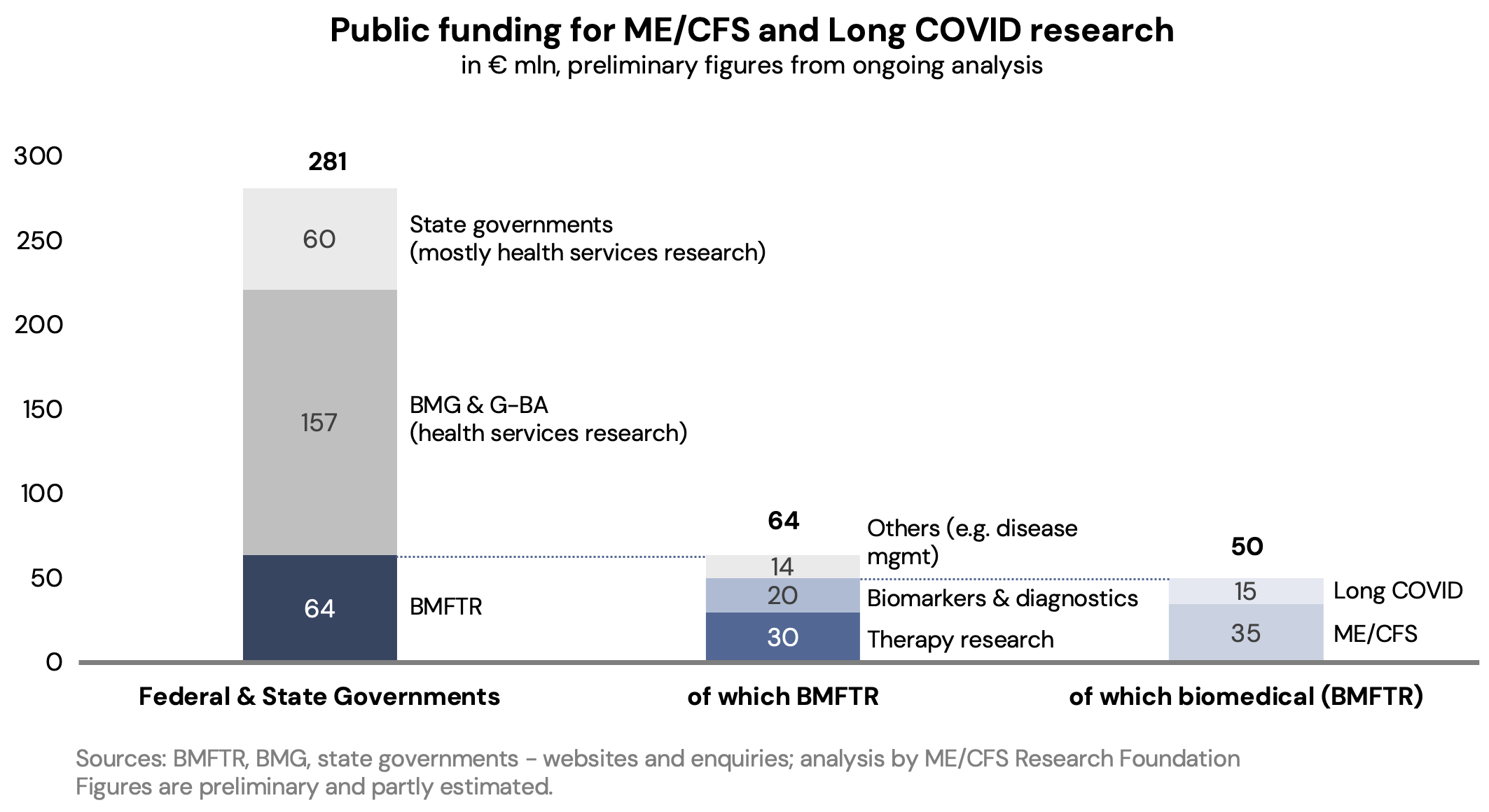
According to a preliminary data analysis by the Foundation, biomarker, diagnostics, and therapy research accounts for 22%, or €50 mln, of all funding allocated so far by the German Federal Government (Federal Ministry of Health (BMG), incl. the Federal Joint Committee (G-BA). and BMFTR) to Long COVID and ME/CFS research until the end of 2025 (€221 mln total). For ME/CFS viewed separately, the share is 16-18%, or approximately €35-40 mln. This has lead to a current underfunding of biomedical research. The goal of the "National Decade" must be to close this gap.
Targeted allocation of funding
Based on the current state of scientific knowledge regarding the suspected ME/CFS and Long COVID disease mechanisms as well as potential therapeutic targets, it is urgently necessary to enable therapy research (in the form of exploratory therapy and Phase II studies with small and well characterised study populations) and accompanying biomarker and diagnostic research through the allocation of funding as early as 2026.
Insights from basic and translational research are essential prerequisites for clinical research. Vice versa, drug research is an effective tool for basic research. There already is a rationale today for conducting clinical trials to specifically test various drugs for the treatment of ME/CFS and Long COVID. Therefore, basic/translational research and clinical research (in the form of therapeutic studies, among others) must be parallelised as quickly as possible. Such parallelisation will allow the validation of existing scientific concepts and hypotheses regarding the disease mechanisms of ME/CFS and Long COVID through testing existing drugs in patients.
The goal must be to generate and validate clinical results for potential therapeutic targets and targeted drugs as early as possible, so that these can subsequently be tested in larger-scale studies. The overarching principle of the "National Decade" must be to maximise time gained in treatment development and the translation into widespread medical care.
To achieve this, from 2026 onwards, there has to be a continuation and increased funding for clinical trials and study platforms already established for ME/CFS and Long COVID (for drug repurposing, among others). Furthermore, the implementation of exploratory therapy studies all the way up to Phase III multi-centre trials must be centrally coordinated within the framework of the "National Decade" and based on uniform and harmonised, already established (and to be further developed) clinical diagnostic criteria and study parameters. Against this background, the establishment of a central platform for the implementation of all clinical trials within the framework of the "National Decade" should be elaborated on. Centres and consortia that are to implement clinical trials should be able to demonstrate sound experience in the field of post-infectious diseases or relevant biomedical research areas. The National Clinical Studies Group (NKSG) is one such example.
Furthermore, incentives should be created to encourage the participation of the pharmaceutical industry, including small and medium-sized enterprises (SMEs) and start-ups, in therapy and diagnostics development. This encompasses both drug repurposing and the development of novel drug candidates.
Active involvement of patient expert representatives
In principle, the "National Decade" requires a comprehensive involvement of various patient expert representatives. This must encompass participation in central steering committees, the design of funding guidelines, the evaluation of funding applications, and as cooperation/consortium partners in funded single/joint projects, among other things.
It is essential to ensure the comprehensive participation of patient expert representatives that possess a group perspective as well as specific expertise. This way it can be guaranteed that the knowledge of people with lived experience, who also possess professional/academic expertise, which is crucial for research into Long COVID and ME/CFS, is incorporated, and that the strategic direction is shaped by including the patient perspective. Examples of such organisations include the German Association for ME/CFS, Fatigatio, and the initiative Long COVID Germany (LCD). The participation of patient expert representatives is a fundamental prerequisite for the strategic success of the "National Decade".
The Foundation’s engagement with the “Nationale Decade” moving forward
The Foundation is currently exploring potential ways to contribute to the development and activities of the "National Decade Against Post-Infectious Diseases" as well as the "Alliance for Post-Infectious Diseases: Long COVID and ME/CFS" (external link). In this context, we are delighted to welcome additional volunteers to our science team, who will support the Foundation’s work with their expertise going forward.
It is of central importance to us to make a meaningful and constructive contribution to the "National Decade". Our goal is to collaborate with all relevant stakeholders to jointly promote advancements in biomarker and diagnostics research, the development of therapies, and the long-term improvement of patient care.
Depending on the strategic direction and funding allocation of the "National Decade", the Foundation will continuously adapt its own research funding programme and align it with the evolving needs of the ME/CFS research landscape. To this end, we are in close contact with other foundations, large patient organisations, and leading experts and will continue to provide updates on current developments.
How can you support the work of the ME/CFS Research Foundation?
While progress has been made, there is still a long way to go before diagnosis, care and treatment of ME/CFS patients will one day become an established medical and social standard. We at the ME/CFS Research Foundation are focussing on biomedical research, which we see as a key element in solving these problems (more on this in our research funding strategy and in the recent half year report, which summarises our activities). To achieve this, we rely on broad support from private donors – those affected, relatives, families, friends, associations, schools, networks, companies, initiatives, event organisers and all supporters. If you are not able to provide direct support, you can share our stories and motivate others to help. Because only together can we achieve. this goal.
We fully translate donations and other support into scientifically excellent research, networking and ultimately visible successes, i.e. improved ME/CFS diagnostics and therapies. We are happy to work together with other organisations and initiatives - please contact us!
We appreciate all kinds of support:
Please subscribe to our newsletter:
And please help us expand our reach by following us on social media:
Thank you for your support!