A summary of the International ME/CFS Conference 2025 has now been published in the medical journal Autoimmunity Reviews . The article contains key takeaways from leading scientists and medical experts in the field of ME/CFS (Myalgic Encephalomyelitis / Chronic Fatigue Syndrome) and Long COVID/post-COVID syndrome. In their expert perspective, the authors outline the latest findings from research, covering recent advances in patient care, insights into disease mechanisms, and treatment approaches.
Scientists summarise latest findings from their investigations
The International ME/CFS Conference 2025 took place in Berlin on 12-13 May 2025. It was the third international research meeting under the scientific direction of the Charité Fatigue Center. The hybrid event brought together 39 speakers from eight countries, and was organised with the support of the ME/CFS Research Foundation. Over the course of two days, a total of around 4.000 people participated in the event, including 200 people on location. A scientific summary of the Conference by the speakers and supporting staff can now be read in the journal Autoimmunity Reviews.
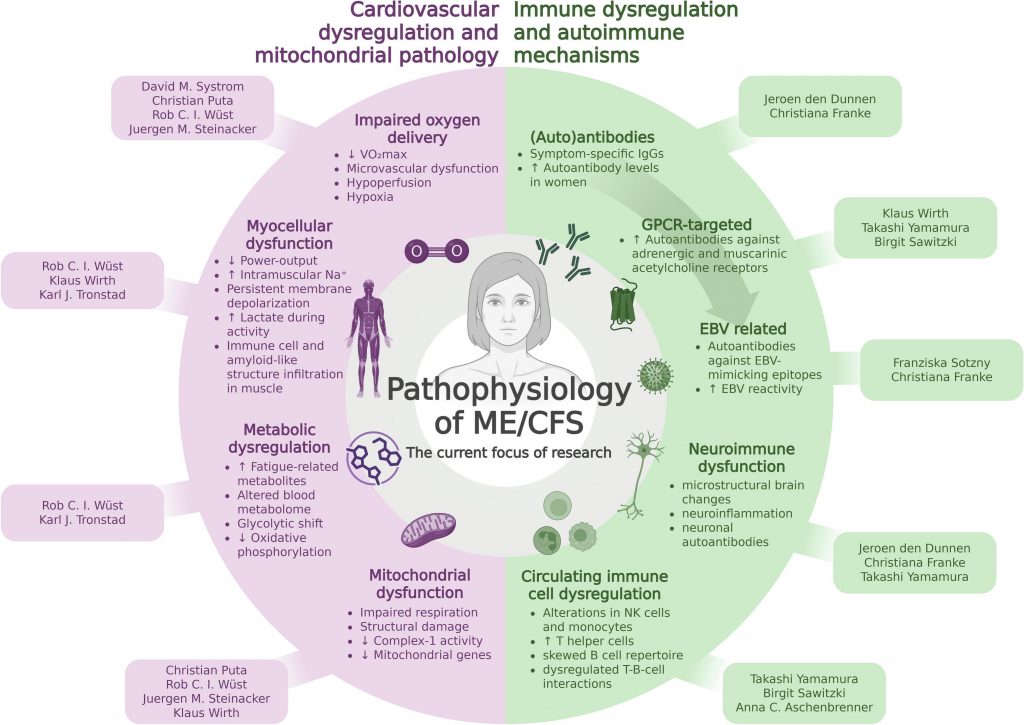
Following introductions by David Putrino and Carmen Scheibenbogen, the article features a section with insights on medical care by Uta Behrends, Kathryn Hoffmann, Fridbjörn Sigurdsson, Claudia Kedor, Michael Stingl, Bernhard Wörmann, and Kristian Sommerfelt. In addition, David Systrom, Rob Wust, Jürgen Steinacker, Christian Puta, and Karl Johan Tronstad summarise findings from their research on cardiovascular dysregulation and mitochondrial pathology in ME/CFS, followed by contributions on the role of immune dysregulation and autoimmunity by Jeroen den Dunnen, Takashi Yamamura, Franziska Sotzny, Christiana Franke, Birgit Sawitzki, and Anna Aschenbrenner. Lastly, two sections on clinical trials feature contributions by Olav Mella, Øystein Fluge, Judith Bellmann-Strobl, Wakiro Sato, Elisa Stein, and Georg Schlieper on the targeted treatment of autoantibodies, as well as contributions by Nina Babel, Laura Kim, Alan Cash, Michael Peluso, David Systrom, David Putrino, and Klaus Wirth on additional therapeutic approaches. The article concludes with highlights from posters by early-career scientists presented during the Conference’s main programme.
Research is advancing, more efforts still needed
In summary, the article outlines the pathophysiology of ME/CFS, which involves immune, vascular, and metabolic dysregulation and describes the increasing evidence in support of autoimmune-mediated and mitochondrial pathomechanisms. With biomarkers to assess symptoms and disease severity currently in development, first clinical trials indeed show promise for the potential efficacy of immunomodulatory and metabolic treatments. Hereto, the article lists all biomedical studies and clinical trials presented at the Conference.
The authors also write that, while public awareness and funding opportunities have increased in the wake of the COVID-19 pandemic due to the emergence of Long COVID, ME/CFS still remains severely under-researched. According to the leading experts, sustained and adequately funded research efforts are urgently required to advance biomedical research and develop targeted therapeutic interventions.
Next International ME/CFS Conference in May 2026
The International ME/CFS Conference 2026 will take place on 7 and 8 May 2026. The hybrid event will once again gather leading scientists and medical experts in Berlin. Registration for online participation is free of charge. Details about the event can be found on the website for this year's International ME/CFS Conference.
How can you support the work of the ME/CFS Research Foundation?
While progress has been made, there is still a long way to go before diagnosis, care and treatment of ME/CFS patients will one day become an established medical and social standard. We at the ME/CFS Research Foundation are focussing on biomedical research, which we see as a key element in solving these problems (more on this in our research funding strategy and in the recent half year report, which summarises our activities). To achieve this, we rely on broad support from private donors – those affected, relatives, families, friends, associations, schools, networks, companies, initiatives, event organisers and all supporters. If you are not able to provide direct support, you can share our stories and motivate others to help. Because only together can we achieve. this goal.
We fully translate donations and other support into scientifically excellent research, networking and ultimately visible successes, i.e. improved ME/CFS diagnostics and therapies. We are happy to work together with other organisations and initiatives - please contact us!
We appreciate all kinds of support:
Please subscribe to our newsletter:
And please help us expand our reach by following us on social media:
Thank you for your support!